Digital audio guides for museums: the complete 2026 guide
Team Gulliveru · September 6, 2026 · 12 min read
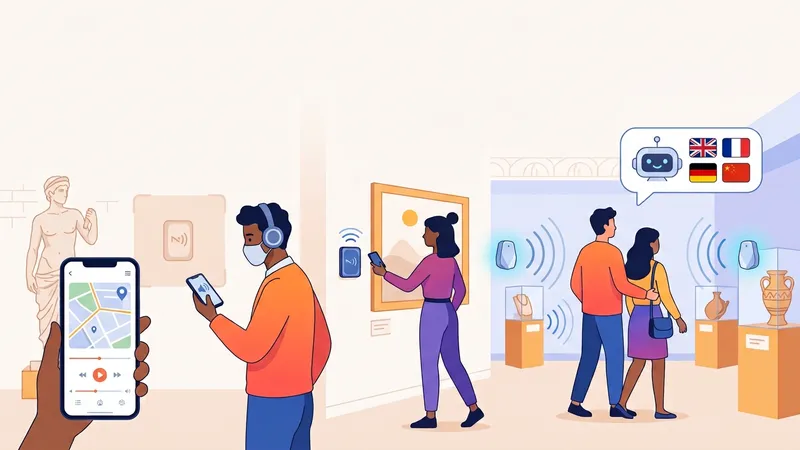

In brief: in 2024, Italy’s state museums recorded 60.8 million visitors, 5.3% more than in 2023 (Ministero della Cultura, 2025). BYOD digital audio guides, which run on the visitor’s own smartphone rather than on dedicated devices, make it possible to offer a multilingual, location-aware experience without investing in hardware. This guide explains how they work, what to consider and where to find out more.
Why are museums rethinking audio guides in 2026?
In 2024, Italy’s state museums welcomed 60.8 million visitors, 5.3% more than in 2023, for total ticket revenue of 328 million euros (Ministero della Cultura, 2025). 2023 had already been a record year, with 57.7 million admissions (Ministero della Cultura, 2024).
This growth is not an isolated case. In the United States, 33% of adults visited a museum in the past year, even though 55% of institutions have not yet returned to pre-pandemic attendance levels (American Alliance of Museums, 2025). The audience is there, but it expects a different experience from the one it had ten years ago.
In Italy, the push also comes from public funding: the PNRR (Italy’s National Recovery and Resilience Plan) has allocated 500 million euros to digital platforms and strategies for access to cultural heritage, with a 2021-2026 horizon (PNRR Cultura, 2025). For many museums, digital is no longer an option but a condition for staying competitive.
| Year | Visitors to Italian state museums |
|---|---|
| 2023 | 57.7 million |
| 2024 | 60.8 million (+5.3%) |
Source: Ministero della Cultura, press releases 2024-2025
What is a BYOD digital audio guide, and how does it differ from dedicated hardware?
A BYOD (Bring Your Own Device) audio guide uses the smartphone the visitor already has in their pocket, instead of a rental device handed out at the entrance. The content, whether audio, text or map, plays directly on their phone, usually through an app or a web page.
The main difference is organisational, not just technical. With dedicated hardware, the museum has to buy or rent a fleet of devices and handle their maintenance, charging and sanitisation between one visitor and the next. With BYOD, that overhead disappears: all that remains is the content, which needs to be kept up to date.
It has to be said plainly: no cost comparison between dedicated hardware and BYOD has been verified by an independent source to date. The figures circulating online come from the blogs of competing vendors, with no stated methodology, and we will not use them here. We have broken down the real cost items, with verifiable sources, in how much does a museum audio guide cost: the real figures.
For a small or medium-sized museum, BYOD lowers the entry threshold: you do not need a hardware budget to start offering a multilingual digital experience. For a museum with heavy footfall or an audience less comfortable with technology, a mix of the two approaches often remains the most realistic choice.
How indoor positioning works: QR, NFC and BLE compared
Three different technologies answer the same question: how does the audio guide know where the visitor is? Each has a use case where it works better than the others.
- QR code: the visitor scans a code next to the artwork. Inexpensive and quick to install, but it requires an active step.
- NFC: simply hold the phone close to a tag. Smoother than QR, but not every smartphone triggers it in the same way.
- BLE (Bluetooth Low Energy): a small beacon detects the visitor’s proximity within a radius of a few metres, without any action on their part.
In practice, a QR+BLE hybrid is often the best-balanced option: QR for individual points of interest (an artwork, a display case), BLE for automatic triggering when someone walks into a room. You do not have to choose a single technology for the whole museum.
The right question is not “which technology is best”, but “which combination keeps the effort asked of the visitor to a minimum, room by room”. It is a user-experience decision before it is a technical one.
Three concrete scenarios
A room with a few high-value works (a picture gallery, a permanent collection): a QR code next to each work performs well, because the visitor stops to look closely anyway. Scanning the code does not interrupt the experience.
A museum with large open spaces (an archaeological museum, a historic palace): BLE beacons reduce friction by starting the audio when the visitor enters a room, without them having to look for anything. The trade-off is that the beacons need to be installed and powered.
A dispersed outdoor site (an archaeological park, a historic town centre): here GPS and QR work better together than BLE, whose range is too short for wide spaces that are not always covered by a stable network.
We will look more closely at the technical and economic comparison between QR, NFC and BLE, with concrete use cases for large and small rooms, in a dedicated article in our Museums cluster.
Artificial intelligence in museums: opportunities and caution
In 2025-2026, 32% of museum visitors had already used a general-purpose AI assistant (such as ChatGPT) to have something explained during a visit, and among those who use AI, 54.7% do so more often than they use a paid audio guide, which stands at 41.0% (Musa Guide, State of AI in Museums 2026, 2026). Audiences are already bringing AI into the galleries, with or without the museum.
But trust cannot be taken for granted. Over 70% of visitors oppose unregulated use of AI in exhibitions, and 45% always want to know when content has been generated by artificial intelligence (American Alliance of Museums, 2026). UNESCO and ICOM have recently launched a global survey specifically on the use of AI in museums (ICOM, 2026), a sign that the question is far from settled.
| Tool used by visitors | Share |
|---|---|
| General-purpose AI assistant (e.g. ChatGPT) | 54.7% |
| Paid audio guide | 41.0% |
Source: Musa Guide, State of AI in Museums 2026 (n=395, UK/US/DE/FR panel)
This is exactly why we are designing Gulliveru’s AI to answer only on the basis of content verified and uploaded by the museum, never generating freely. It does not remove visitors’ caution, but it takes that caution seriously instead of ignoring it.
What can museums actually measure with a digital audio guide?
A digital audio guide is not just a storytelling channel: it is also a source of data that did not exist before. Every content activation, every room visited, every tour completed leaves a useful trace.
In concrete terms, a museum can see which rooms hold visitors longest, which points of interest are systematically skipped, and at what times of day the densest flows build up. This is information that today is often gathered by intuition, or not gathered at all.
In practice, the most useful data falls into four areas:
- Dwell time per room or point of interest: where visitors actually stop, not where the route takes them
- Tour completion rate: how many reach the end and where they drop off
- Points of interest never activated: content that exists but that nobody listens to
- Hourly and seasonal distribution of flows: useful for planning staff rotas and extended opening hours
During the design phase of Gulliveru, in conversations with museum professionals, the most recurrent request was not “more technology” but “less uncertainty” about how visitors actually move through the spaces. It is a problem of missing data before it is a problem of storytelling.
This data becomes useful when it turns into concrete decisions: reorganising a route, moving an information panel, understanding whether a new room is working. We will return to this topic, with practical examples of how to read heatmaps, in a dedicated follow-up.
Multilingual support is no longer optional
42% of visitors across a sample of Italian cultural sites come from abroad, from 144 different countries, with a language distribution of roughly 38% Italian, 26% English, 10% Spanish, 8% French and 6% German (industry figure reported by amuseapp, 2025). This figure should be treated as indicative rather than as independent research, but it is consistent with what has been observed elsewhere in the sector.
Covering all of these languages with human narration recorded in a studio is rare, for reasons of cost and time. The most realistic combination is translation supervised by real people plus AI voice synthesis for production: it preserves quality and naturalness without requiring a voice-over session for every new language.
In practice, the workflow looks like this: a human translator reviews and corrects the machine-translated text, then AI voice synthesis generates the audio in each language from the approved text. If the content changes, whether a new acquisition or a historical correction, you update the text and regenerate the audio, without having to call a voice actor back into the studio.
This is not a minor detail. For a foreign visitor, understanding what they are looking at in their own language is often the difference between a memorable experience and a visit they simply sit through.
Common mistakes to avoid when choosing a digital solution
Some mistakes come up again and again when a museum tackles the digitisation of its audio guide for the first time.
The first is choosing the technology before the content: investing in beacons or hardware before deciding what to tell, room by room, almost always leads to an underused system. The content (texts, translations, narrative priorities) takes more time than the technology that delivers it.
The second is underestimating maintenance: an audio guide is not a project that ends at launch. Content to update, new languages to add, data to interpret: without a plan for ongoing management, perceived quality drops quickly after the first few months.
The third is skipping the test phase with real visitors: an indoor positioning setup that works during commissioning can behave differently with hundreds of different smartphones and crowded Wi-Fi networks. It is worth testing with a small group before the full launch.
Where to start if your museum is considering a digital solution
Before choosing a vendor, it is worth getting clear on four points: how many rooms or points of interest you want to cover, which languages your audience really needs, what kind of reporting you need to make decisions, and how much budget you can commit, not only to launch but to maintenance over time.
To these you should add a fifth question, often overlooked: who, internally, will be responsible for keeping the content up to date once the platform is live? You do not need a full-time dedicated role, but you do need someone to take ownership of it.
You do not need to have all the answers already. You need to start asking the right questions, and to talk to people who know the sector from the inside.
Gulliveru is preparing to launch: we are building exactly this, a BYOD platform with hybrid positioning, Gulliveru AI running on verified content, and visitor-flow analytics, designed for museums that do not want to invest in expensive hardware. Request a demo or join the pilot program to be among the first to try it.
Frequently asked questions
How much does a digital audio guide cost for a museum?
It depends above all on the choice between dedicated hardware and a BYOD solution. There is no verified, comparable industry data: we have broken down the real cost items, with verifiable sources, in how much does a museum audio guide cost: the real figures.
BYOD audio guide vs dedicated devices: which is the better choice?
BYOD reduces the upfront investment and removes the need to manage a fleet of devices, but it requires visitors to have their smartphone and headphones with them. Dedicated devices remain useful where connectivity is poor or the audience is less comfortable with technology.
How does an audio guide work with QR codes, NFC or BLE beacons?
QR and NFC trigger content when the visitor scans or taps their phone at a precise point; BLE beacons detect proximity automatically over a wider radius. A hybrid combination covers both individual points of interest and entire rooms.
Could AI audio guides give visitors incorrect information?
This is the main perceived risk of AI in museums: over 70% of visitors oppose unregulated use of artificial intelligence in exhibitions (AAM, 2026). That is why a museum AI assistant should answer only on the basis of content verified by the museum, rather than generating freely.
Does a multilingual audio guide improve satisfaction among foreign visitors?
Industry data points to a direct link between language availability and the satisfaction of international visitors, although the figures published so far come from individual vendors rather than independent research. It nonetheless remains one of the most frequent requests from foreign audiences.
In summary
2026 is the moment when Italian museums, driven by the growth in international visitors and by PNRR investment, have to choose a digital strategy: not whether to do it, but how. BYOD (bring your own smartphone) lowers the barrier to entry, hybrid positioning covers large and small rooms alike, and AI can help only if it respects visitors’ genuine caution.
Gulliveru is building this platform now, ahead of launch. If your museum or cultural institution wants to be among the first to try it, request a demo or join the pilot program: we will get in touch about the next steps.
Frequently asked questions
How much does a digital audio guide cost for a museum?
It depends above all on the choice between dedicated hardware and a BYOD solution (based on the visitor's own smartphone). There is no verified, comparable industry data: we have broken down the real cost items, with verifiable sources, in our dedicated article on the cost of a museum audio guide.
BYOD audio guide vs dedicated devices: which is the better choice?
BYOD reduces the upfront investment and removes the need to manage a fleet of devices, but it requires visitors to have their smartphone and headphones with them. Dedicated devices remain useful where connectivity is poor or the audience is less comfortable with technology.
How does an audio guide work with QR codes, NFC or BLE beacons?
QR and NFC trigger content when the visitor scans or taps their phone at a precise point; BLE beacons detect proximity automatically over a wider radius. A hybrid combination covers both individual points of interest and entire rooms.
Could AI audio guides give visitors incorrect information?
This is the main perceived risk of AI in museums: over 70% of visitors oppose unregulated use of artificial intelligence in exhibitions. That is why a museum AI assistant should answer only on the basis of content verified by the museum, rather than generating freely.
Does a multilingual audio guide improve satisfaction among foreign visitors?
Industry data points to a direct link between language availability and the satisfaction of international visitors, although the figures published so far come from individual vendors rather than independent research. It nonetheless remains one of the most frequent requests from foreign audiences.