Digital audio guides: do they really increase engagement?
Team Gulliveru · September 13, 2026 · 7 min read
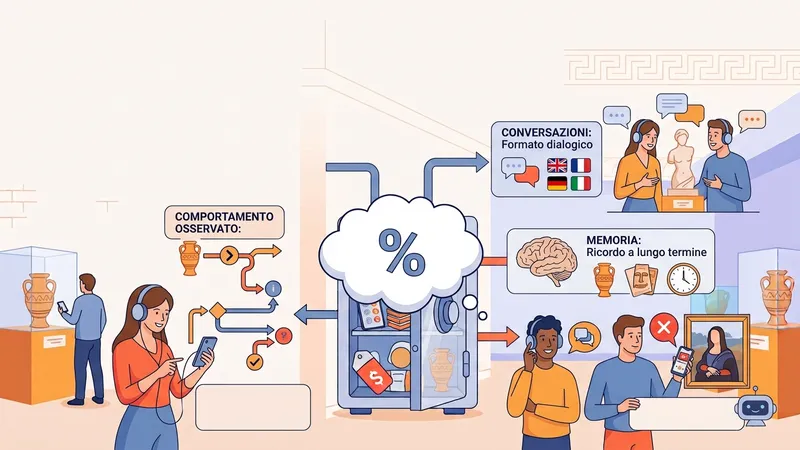

In brief: if you search for “how much does a digital audio guide increase engagement”, you expect a percentage. There isn’t one, in any verifiable academic or institutional research. What does exist are specific, real studies on visitor behaviour, memory and distraction: less convenient to sum up in a single number, but far more useful for understanding what actually works.
Why there is no “engagement increase” measured as a percentage
Before writing this article, we looked for a tier 1-2 academic or institutional study that quantified an increase in engagement linked to the use of an audio guide. There isn’t one. The figures circulating online as “+X% engagement” cannot be traced back to any serious, verifiable public research.
What does exist is more interesting, even if harder to turn into a headline: a handful of real studies, carried out by museums and researchers, that observe what visitors actually do when they use an audio guide. Not a composite index, but observed behaviour.
In this article we report what they actually say, institution by institution, instead of building a number that does not exist in the literature.
What actually happens when visitors use an audio guide
The most detailed study we found comes from the British Museum, presented at the Museums and the Web conference in 2015: six weeks of ethnographic observation, more than 250 visitors interviewed or observed (British Museum, “An Audio State of Mind”, 2015).
The results are a long way from the image of a visitor following a guided route step by step: only about 10% followed the tour linearly from start to finish. 75% “jumped” between contents in a non-linear way, looking for whatever interested them most at that moment. Another 15-20% used the audio guide only occasionally and sporadically.
This finding, however dated and however much it refers to a traditional audio guide (not BYOD, with your own phone), suggests something uncomfortable for anyone selling “linear guided routes”: visitors do not want to be led step by step. They want to be able to choose, skip ahead, go back. A rigid system risks being used only in part, no matter how technologically advanced it is.
The link between audio guides and memory: the Museum of London study
A peer-reviewed study conducted with the Museum of London and the organisation VocalEyes compared three groups of visitors in front of nine photographs: one with no audio, one with a standard audio guide, one with audio description (Hutchinson et al., Museum Management and Curatorship, 2021).
What was measured was not an abstract increase in “engagement” but something more concrete: the groups with audio remembered the works better a month later, and were more inclined to want to come back and engage with the collection again. It is one of the few real pieces of evidence that audio, when done well, leaves a more lasting trace than silence alone in front of a work.
Conversations are worth more than minutes
A study by the Open University compared two audio guide styles in front of the same paintings: one scripted, with a monologue narration, and one dialogic, built as a spontaneous conversation between two voices (Elliston & FitzGerald, Open University, 2012).
The result: the dialogic version generated 35 “on-topic” conversational exchanges between visitors in front of a single painting, against 20 for the monologue version. It is not an “engagement” percentage, but it is an observable, concrete finding: almost twice as many verbal interactions triggered by the same content, told in a different way.
The point we find most relevant for anyone designing content today: the difference was not in the technology used to play the audio, but in how the script was written. A detail that no comparison between hardware devices can capture.
When technology distracts instead of engaging
Not all the data is positive, and it is only fair to say so. An often-cited case concerns a Brooklyn Museum pilot with video content on a handheld device (not pure audio): according to an informal account by the project’s curator, about 80% of visitors’ visual attention shifted to the screen instead of the actual artwork (cited in DiRienzo, Museums and the Web 2017). It is an anecdotal observation, not a systematic study, and it concerns video content; but the risk it describes is real.
A more recent study, from 2025, comparing robotic guides and mobile audio guides in a Korean museum setting, reaches a conclusion we consider the most important in this whole article: it is the quality of the content, not the novelty of the device, that determines how engaged a visitor stays (Museum Management and Curatorship, 2025).
What this means for a museum evaluating a digital audio guide today
Taken together, these studies tell a more useful story than any invented percentage: visitors do not want to be led rigidly, they remember more when the content genuinely engages them (not simply because audio exists), conversations are worth more than minutes of passive listening, and technology can distract if the content is not up to standard.
This is exactly why, at Gulliveru, the focus is not on “how many devices” or “how much technology”, but on the quality and verifiability of the content, starting with Gulliveru AI’s multilingual narration, designed to answer with information verified by the museum, not to generate plausible but unchecked replies.
If your museum is evaluating a digital solution and wants to start from the content rather than the device, request a demo or join the pilot program: we will tell you how we are building Gulliveru.
Frequently asked questions
Do audio guides really increase visitor engagement?
No academic or institutional study quantifies a generalisable percentage increase. The real studies measure more specific things: how much visitors remember after a month, how many conversations a dialogic audio guide generates compared with a monologue, how many people complete the tour.
How many visitors actually complete an audio guide tour?
In the most detailed study available (British Museum, 2015), only about 10% of visitors followed the tour linearly from start to finish; 75% jumped between contents in a non-linear way.
Can audio guides distract rather than engage?
Yes, in some documented contexts. One study observed visual attention shifting to the device screen instead of the artwork, in a pilot with video content, not pure audio guide. Content quality matters more than the novelty of the device, according to a 2025 study.
What actually increases engagement, if not the technology itself?
The studies point to content quality and a conversational format as more decisive factors than the technology used to deliver it. An audio guide with dialogic narration generated almost twice as many verbal interactions as a monologue version in the same setting (Open University, 2012).
In summary
There is no verified percentage for how much digital audio guides increase engagement, and anyone publishing one online without a source is not describing reality. What does exist is more useful: visitors want freedom of choice, content matters more than the device, and the conversations generated are worth more than minutes of passive listening.
It is precisely these principles, not the technical specifications of a device, that guide how we are designing the next generation of multimedia audio guides.
Frequently asked questions
Do audio guides really increase visitor engagement?
No academic or institutional study quantifies a generalisable percentage increase. The real studies measure more specific things: how much visitors remember after a month, how many conversations a dialogic audio guide generates compared with a monologue, how many people complete the tour.
How many visitors actually complete an audio guide tour?
In the most detailed study available (British Museum, 2015), only about 10% of visitors followed the tour linearly from start to finish; 75% jumped between contents in a non-linear way, looking for whatever interested them most.
Can audio guides distract rather than engage?
Yes, in some documented contexts. One study observed visual attention shifting to the device screen instead of the artwork, in a pilot with video content, not pure audio guide. Content quality matters more than the novelty of the device, according to a 2025 study.
What actually increases engagement, if not the technology itself?
The studies point to content quality and a conversational format as more decisive factors than the technology used to deliver it. An audio guide with dialogic narration generated almost twice as many verbal interactions as a monologue version in the same setting.