How much does a museum audio guide cost? The real figures
Team Gulliveru · September 7, 2026 · 7 min read
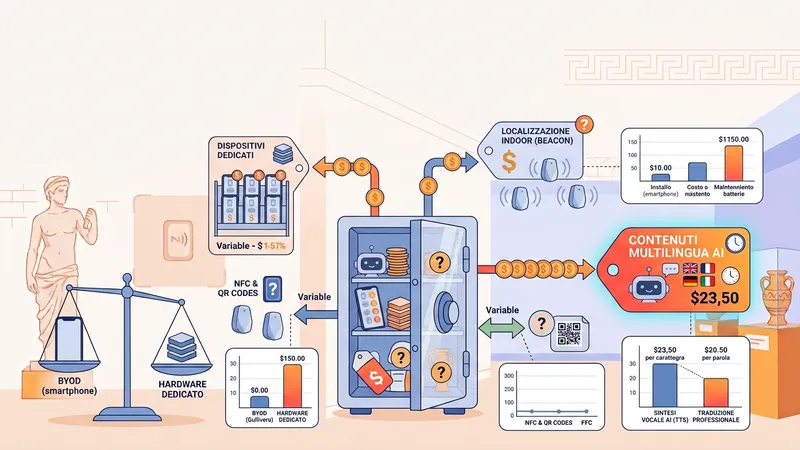

In brief: there is no single, verified market price for a museum audio guide; no vendor, our own sector included, publishes comparable, audited data. What we can do is honestly break down the real cost items: device rental, BLE beacons, and multilingual content production with AI. The last one is the only item that can be calculated precisely, starting from verified public rates.
Why there is no single price for a museum audio guide
If you search for “how much does a museum audio guide cost”, you probably expect a number. There isn’t one, and whoever publishes one online, including some of our competitors, does so without citing a source or a verifiable methodology. We checked thoroughly before writing this article, and we did not find a single comparable, verified industry figure.
What does exist are the individual cost items that make up the final solution: devices (if you choose them), indoor positioning, and content production. Each has a market with real, public prices. The rest, meaning how much of each your specific museum needs, depends on variables only you know: number of rooms, languages required, visitor flow.
In this article we break down each item with verifiable data, instead of giving a final figure that nobody could check.
The cost of renting dedicated devices
A London-based audio guide rental company publishes a real, verifiable price: £3.50 per device per day, with no minimum order, including transmitter, microphone, receiver and headphones (tourguide.systems, prices published on the site). It is a figure from the events and guided-tour sector in general, not museum-specific, but it is one of the very few public, verifiable numbers that exist in this market.
That figure covers only the rental of the individual device. It does not include: the content management software, integration with indoor positioning, staff training, or the logistics of handing out and collecting devices at the entrance, items that in the day-to-day running of a museum weigh as much as the device itself.
For a museum with large visitor flows (think of the tens of thousands of monthly visitors at Italian state museums, which in 2024 reached a combined total of 60.8 million admissions, Ministero della Cultura, 2025), multiplying that daily cost by hundreds of devices in use at the same time gives a concrete idea of the scale of the recurring investment.
The cost of BLE beacons for indoor positioning
A BLE beacon, the small device that detects a visitor’s proximity to automatically trigger a piece of content, costs roughly between $5 and $25 per unit, with the variation explained mostly by build quality and battery life (Kontakt.io, beacon buyer’s guide). Kontakt.io is one of the most established manufacturers in the sector, with a public reference catalogue.
The price of a single beacon, however, tells only part of the story. A real installation requires: physical installation in every room or point of interest, a battery replacement plan (cheap beacons typically last 1-2 years), and a fleet management system if there are dozens or hundreds of beacons.
It is a common mistake to compare “the price of a beacon” with “the price of a QR code” as if they were equivalent. A QR code has no recurring maintenance cost; a beacon does. The honest comparison is not between two numbers, but between two different cost structures over time.
QR and NFC: the near-zero cost of the cheapest option
Compared with beacons, QR codes and NFC tags have an almost non-existent entry cost. A QR code is printed: the marginal cost is that of the printing itself, not the technology. A physical NFC tag has a modest unit cost, although reliable public figures for wholesale purchases are scarce; on this point we prefer not to quote precise numbers found only on wholesale marketplaces, which are hard to verify.
What you lose with QR and NFC is automation: the visitor has to take an action (scan, hold the phone close), whereas a beacon detects their presence without asking anything of them. It is a trade-off between cost and how smooth the experience is, not a one-sided comparison.
The real cost of multilingual narration: here the numbers actually exist
Unlike devices and beacons, the cost of AI speech synthesis (TTS) is public, verifiable and the same for everyone: providers publish precise rates on their own websites.
ElevenLabs, one of the most widely used TTS providers for multilingual content, charges between $0.05 and $0.10 per 1,000 characters depending on the model chosen (ElevenLabs, API pricing page, 2026). From here we can make a verifiable calculation, not a guess pulled out of thin air.
Our calculation: one hour of narration is roughly equivalent to 45,000-50,000 characters. Generating it in 5 languages, at the price of the ElevenLabs multilingual model ($0.10/1,000 characters), costs between $22.50 and $25 for the AI audio alone. This is our own calculation, based on a verified public rate; not an industry figure, but something anyone can recalculate and verify for themselves.
To this you add professional translation of the source text, which in the Italian/European market has average rates of around €0.08-0.10 per word for the Italian-English pair (Translated.com, translation rates), with variations according to content complexity and target language.
Compared with a studio voice-over session for every single language, which means booking a studio and a voice actor and repeating the process for every revision of the text, the combination of supervised translation plus AI TTS has a much lower and more predictable marginal cost per additional language.
BYOD vs dedicated hardware: where the budget really goes
Putting the items together, the picture that emerges is not “one option costs less than the other”, but “the two options shift the budget onto different items”.
With dedicated hardware, the budget is concentrated on purchasing or renting devices, fleet management and logistics: recurring items, largely proportional to the number of simultaneous visitors. With BYOD, that cost almost entirely disappears, and the budget shifts to content production, translation and speech synthesis: items that scale with the number of languages and points of interest, not with the number of visitors.
For a museum with a limited budget and a growing international audience, this second cost profile tends to be more sustainable over time: it grows with the content you decide to produce, not with every single visitor who walks through the door.
Frequently asked questions
How much does a digital audio guide really cost for a museum?
There is no single figure: it depends on how many devices you need (if you choose dedicated hardware), how many beacons for indoor positioning, and how much it costs to produce content in several languages. The most predictable item is multilingual AI narration, which can be calculated precisely from the public rates of TTS providers.
Which is the better deal, device rental or BYOD?
Rental has a recurring, predictable cost per device, plus fleet management on top. BYOD removes that recurring cost but shifts the investment to content production and software. There is no answer that holds for every museum.
How much do BLE beacons cost for a museum?
The price of a single BLE beacon generally ranges between $5 and $25 depending on quality and battery life (Kontakt.io), but the real cost of an installation also includes physical installation, maintenance and battery replacement over time.
How much does it cost to translate and narrate an audio guide in several languages?
With a TTS provider such as ElevenLabs, generating one hour of narration in 5 languages costs roughly between $22 and $25 for the AI audio alone (ElevenLabs, 2026). Professional translation of the text is added separately, at market rates of around €0.08-0.10 per word (Translated.com).
In summary
Anyone promising a single price for a museum audio guide is oversimplifying, or has no verifiable source behind that number. The honest breakdown, devices, beacons, multilingual content, shows where the budget really goes on each of the two paths, BYOD or dedicated hardware.
Gulliveru is building a BYOD platform designed to make this second cost structure, the one tied to content rather than devices, simple to manage. Request a demo or join the pilot program to talk it through with us.
Frequently asked questions
How much does a digital audio guide really cost for a museum?
There is no single figure: it depends on how many devices you need (if you choose dedicated hardware), how many beacons for indoor positioning, and how much it costs to produce content in several languages. The most predictable item is multilingual AI narration, which can be calculated precisely from the public rates of TTS providers.
Which is the better deal, device rental or BYOD?
Rental has a recurring, predictable cost per device, plus fleet management on top. BYOD removes that recurring cost but shifts the investment to content production and software. There is no answer that holds for every museum.
How much do BLE beacons cost for a museum?
The price of a single BLE beacon generally ranges between $5 and $25 depending on quality and battery life, but the real cost of an installation also includes physical installation, maintenance and battery replacement over time: items often ignored in superficial comparisons.
How much does it cost to translate and narrate an audio guide in several languages?
With a TTS provider such as ElevenLabs, generating one hour of narration in 5 languages costs roughly between $22 and $25 for the AI audio alone. Professional translation of the text is added separately, at market rates of around €0.08-0.10 per word.